The Aberrant Typology

Understanding the Interaction Between the Ego and the Sacred Symbol

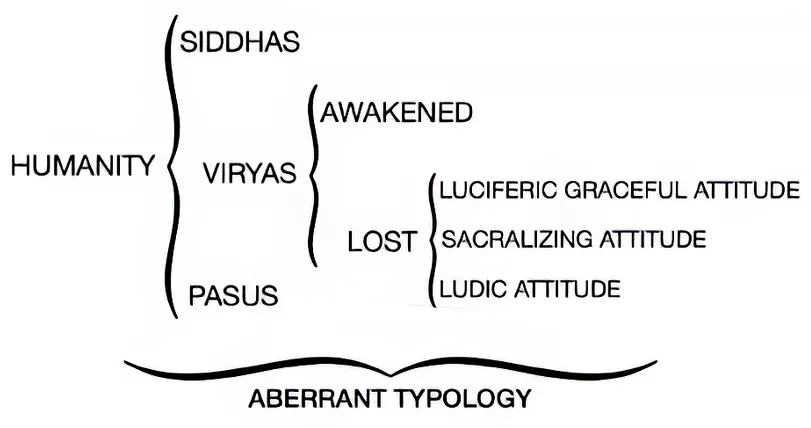
The Aberrant Typology constitutes a specific psychological classification system designed to categorize the behavior of the Lost Virya, or the sleeping spiritual man, based on his reaction to a Sacred Symbol. Within this system of knowledge, a Sacred Symbol is defined not merely as a religious icon, but as any object, idea, or cultural representation that acts as a window to a metaphysical truth or a universal archetype. When a Lost Virya confronts such a symbol, a dramatic tension arises between his Ego and the energy emanating from that symbol.
This interaction is termed the fundamental ethical act. The typology is not based on racial or biological characteristics, but strictly on the ethical posture the individual adopts during this confrontation. It serves as a diagnostic tool to understand how deeply an individual is enmeshed in the cultural webs of the material world and how close or far they are from spiritual awakening.

The Fundamental Ethical Act and the Balloon Law

To illustrate the dynamics of this interaction, the wisdom employs the Allegory of Mr. Aberro and the Balloon. In this analogy, the Sacred Symbol is represented by a balloon connected to a gas cylinder. As the gas, which represents the psychoid energy of the archetype, inflates the balloon, it grows in size and power, creating a situation of increasing dramatic tension for Mr. Aberro, who represents the Lost Ego.
The behavior of the gas and the balloon follows what is called the Balloon Law, which dictates that the symbol will naturally expand and attempt to capture the attention and energy of the subject.

The Aberrant Typology is derived entirely from the specific reaction the subject has to this expanding force. There are three possible reactions: one can attempt to deflate the tension by mocking it, one can submit to the tension and be consumed by it, or one can master the tension through a graceful detachment. These reactions define the three types: the Ludic, the Sacralizing, and the Luciferic Funny.


The Characteristics of Each Type

1. The Ludic Type

The Ludic Attitude and the Degradation of Meaning

The first and most common type in the Aberrant Typology is the Ludic Type. This personality is characterized by a fundamental fear of the transcendent reality that lies behind symbols. When the Ludic Virya confronts a Sacred Symbol, whether it be a concept of God, a patriotic flag, or a profound truth, he experiences the dramatic tension as a threat to his stability. To neutralize this threat, he adopts a playful or mocking attitude, treating the symbol as a game or a toy.
In the allegory of the balloon, the Ludic type cuts the connection to the gas cylinder and steals the balloon to play with it. By doing so, he stops the influx of archetypal energy, effectively deflating the symbol. This act degrades the Sacred Symbol, stripping it of its metaphysical power and reducing it to a mere cultural object or a piece of information that can be manipulated without risk. This attitude is described as a form of strategic suicide because, by denying the dramatic and dangerous nature of reality, the Ludic type plunges himself into a state of gnoseological colorblindness. He refuses to see the chains that bind him, preferring to live in a fantasy where everything is a game and nothing has serious consequences.

This psychological profile is closely linked to what are termed particular professions, defined as societal roles that occupy only a portion of a person’s life and follow a fixed schedule, allowing the individual to step in and out of the role as if it were a costume. The Ludic man merely plays at his occupation, but he carefully frames this activity to ensure it never consumes his entire existence. While this prevents him from being totally possessed by the archetype of his profession, it also prevents him from ever achieving true seriousness or spiritual depth. He remains a sacrilegious player, constantly moving the boundaries of reality to ensure he never has to face the Absolute.

2. The Sacralizing Type

The Devotional Subject and the Loss of Individuality

The second category is the Sacralizing Type, which stands in direct opposition to the Ludic mentality. When the Sacralizing Virya confronts a Sacred Symbol, he does not flee from the tension or mock it; instead, he surrenders to it completely. In the balloon allegory, this type watches in awe as the balloon inflates indefinitely until it becomes a monstrous entity that swallows him whole. This process is referred to as psychic phagocytation, where the individual Ego is absorbed and digested by the universal archetype.
The Sacralizing type believes that the expanding symbol represents an absolute truth or a divinity that demands his total submission and service. He projects his will into the symbol, fueling its growth with his own energy, and interprets the resulting dramatic tension as a religious ecstasy or a call to duty. This type is intrinsically linked to collective professions, which are roles that demand the totality of a person's vital time and erase the distinction between the individual and the function. 
A person in a collective profession does not merely act the part; he becomes the part twenty-four hours a day, and his individual personality is replaced by the mask of the archetype he serves. While the Ludic type degrades the symbol to maintain a false sense of freedom, the Sacralizing type allows the symbol to degrade him, turning him into a mere appendage of a cultural superstructure. His ethics are teleological, meaning he acts always for the sake of the end goal dictated by the archetype, whether that goal is the victory of the Fatherland, the glory of God, or the sanctity of the Law. While this type may exhibit great strength and fanaticism, he is spiritually lost because he has surrendered his central point of individuality to an external power.

3. The Luciferic Funny Type

The Path of the Wise Warrior and the Graceful Will

The third and superior category in the Aberrant Typology is the Luciferic Funny Type,. This attitude represents the only path toward true spiritual liberation and is the prerequisite for the Hyperborean Initiation. The term funny here does not imply clownish humor, but rather a state of Grace or Graciousness. When the Luciferic Funny Virya confronts the expanding Sacred Symbol, he neither degrades it like the Ludic nor submits to it like the Sacralizing. Instead, he exercises a technique of strategic opposition. In the allegory, he calmly closes the valve of the gas cylinder, stopping the flow of archetypal energy. He suspends the dramatic tension. He observes the symbol for what it is, an external phenomenon, and refuses to be mesmerized by it. He smiles at the illusion, recognizing the artificial nature of the situation without losing his own center of gravity.
This attitude allows the Virya to distinguish his true Self from the cultural elements that seek to enslave him. It is an act of absolute spiritual autonomy. The Luciferic Funny individual possesses a Gracious Will, which enables him to stand above the pairs of opposites, such as good and evil, that entrap the other types,. He does not need to destroy the symbol, nor does he need to worship it; he simply isolates himself from its influence.

This isolation is the construction of an inner fortress, or Odal Archemona, where the Spirit remains untouchable,,. This type corresponds to the aristocratic ethic of the Kshatriya or the Wise Warrior, who acts not out of obligation to a moral law or a religious deity, but out of pure Honor. By maintaining this state of alert detachment, the Luciferic Funny type prepares his spirit to receive the Gnosis that will allow him to break the chains of the material world and return to the Origin. He is the only one capable of resisting the great deceptions of the world because he sees the comedy inherent in the drama of creation.



Key Points

The Aberrant Typology is a system of psychological classification within the Hyperborean Wisdom designed to categorize the behavior of the "Lost Virya" (the sleeping spiritual man) based on his specific reaction during the "Fundamental Ethical Act." This act is defined as the moment the Ego confronts a Sacred Symbol. The typology is strictly based on the ethical attitude the Ego adopts when facing the dramatic tension generated by a sacred symbol.

Three specific types are defined, ranked from lowest to highest in terms of strategic orientation:

1. The Ludic Type (The Player)
This type reacts with a mixture of fascination and fear. Unable to withstand the tension, the Ludic type resolves it by degrading the symbol. In the allegory, Mr. Aberro cuts the balloon loose to play with it, ignoring the gas cylinder. Mr. Aberro represents the Lost Ego, and the balloon represents the sacred symbol.

2. The Sacralizing Type
This type reacts with submission and sublimation. The Ego reduces its will to a minimum, allowing the Balloon Law to operate fully. The symbol "inflates" until it generates an "illusion of size" that overwhelms and phagocytizes (absorbs) the subject.

3. The Luciferic Funny Type
This is the superior type, located "one step away" from the Awakened Virya. This attitude allows the Virya to suspend the dramatic tension through Gracious Will (or Charismatic Will).

The Honor of a Shared Spiritual Origin

The Luciferic Funny type, by possessing this Gracious Will and being capable of the Luciferic attitude, becomes a charismatic center of the Mystique. They radiate this Charisma, which is perceived by other Viryas through the blood. This type corresponds to the Kshatriya (Warrior) caste, which is naturally apt to establish noological contact with the Spirit and assume the Spiritual Power, unlike the Priestly caste (associated with the Sacralizing type) which only influences the soul.

The Luciferic Funny type alone possess the Valor and Honor (defined as the act of the Gracious Will) necessary to transcend the illusory forms of the material world, connect with the Paraclete, and synchronize with the leaders of the Pure Blood in the strategy of spiritual liberation. They do not submit to the leader as a slave to a master (Sacralizing) nor mock the leader (Ludic), but are linked by the Honor of a shared spiritual origin.